Choosing Chinese batteries for commercial use is not simply a matter of comparing prices or rated capacity. The right decision connects safety, operating costs, service support, and long-term performance. For buyers asking how to choose batteries for commercial applications, the evaluation should begin with the actual working environment. A warehouse forklift, delivery vehicle, telecom cabinet, and solar storage system require different battery designs.
Chinese manufacturers offer extensive choices, including lithium iron phosphate, nickel-manganese-cobalt, lead-acid, and specialized industrial systems. Each chemistry behaves differently under heat, cold, frequent charging, and heavy discharge. A battery that performs well in a controlled showroom may lose efficiency in a dusty warehouse or an outdoor fleet yard. Small details matter. Check the battery management system, cell consistency, enclosure protection, charging limits, and thermal controls. Look beyond the brochure.
Reliable selection also requires evidence from the supplier. Request test reports, production traceability, warranty terms, safety certifications, and clear replacement procedures. Independent testing can reveal capacity loss, overheating risks, and charging irregularities that marketing materials may not mention. Supplier audits are valuable too. Review factory quality systems, sample records, export experience, and technical response times.
No checklist is flawless. Commercial conditions change. Electricity prices rise, routes become longer, and operators may ignore charging instructions. A practical decision should include these imperfect realities. Compare total cost over the expected service life, not only the purchase invoice. This guide explains how to assess Chinese battery suppliers, verify technical claims, and match battery performance with commercial demands. The goal is a safer, more predictable investment with fewer surprises after deployment.
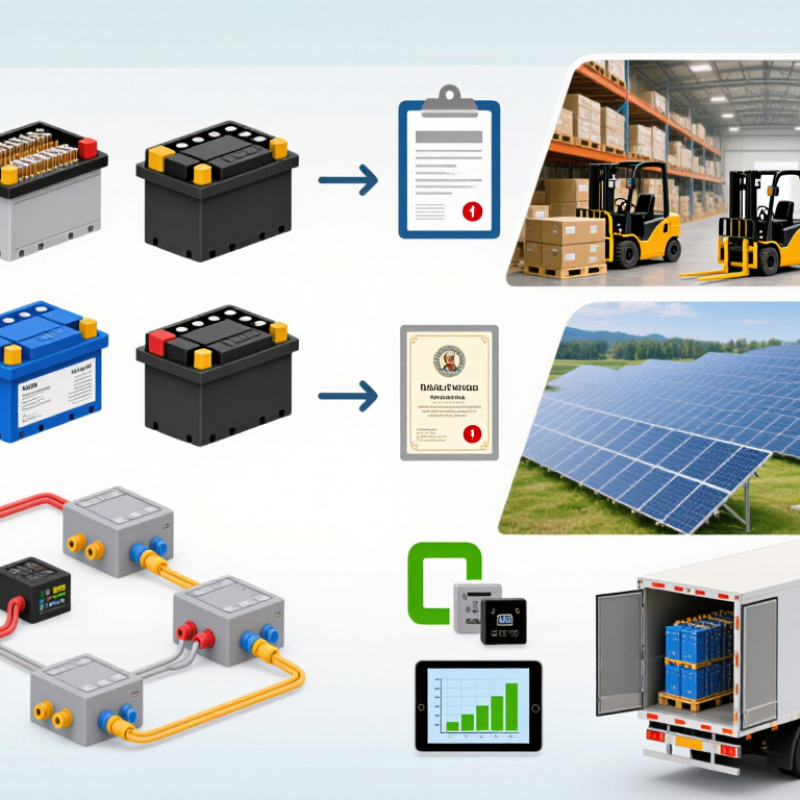
Before choosing top Chinese batteries for commercial use, define the job precisely. Record the equipment’s voltage, continuous load, peak demand, daily operating hours, and backup duration. A warehouse vehicle may need high discharge power, while a solar system may prioritize daily cycling. These are different designs. Measure real consumption, not only the manufacturer’s estimate. I have seen projects fail because short startup surges were ignored.
Operating conditions matter just as much. Note ambient temperature, humidity, dust, vibration, installation height, and available space. A battery working beside a hot compressor needs different protection from one installed in a clean indoor room. Check cycle-life testing, usable capacity, charging limits, cell consistency, and battery management system functions. Ask for traceable test reports and clear warranty conditions. Specifications can look impressive, yet field performance may still disappoint.
Tips: Build a 24-hour load profile before requesting quotations. Include the highest expected current and a safety margin. Confirm whether the system supports remote monitoring, fault alarms, and safe isolation. Review maintenance access before installation; a compact cabinet is not always practical. Also, test a sample under your actual duty cycle when possible. I sometimes choose a slightly larger battery after testing, although this increases cost. That compromise may prevent frequent deep discharges and unexpected downtime.
Define commercial battery requirements and operating conditions before selecting a battery chemistry.
The chart compares indicative cycle-life midpoints for commonly used commercial battery chemistries at approximately 80% remaining capacity. Lithium iron phosphate (LFP) is often preferred for frequent cycling because of its long service life and strong thermal stability. NMC offers higher energy density but typically requires tighter thermal and safety controls. Lead-acid batteries have lower upfront costs but generally provide fewer cycles, while sodium-ion batteries are an emerging option for cost-sensitive and moderate-energy-density applications. Actual performance depends on depth of discharge, ambient temperature, charging limits, installation quality, and the battery management system.
Indicative ranges used: LFP 3,000–7,000 cycles; NMC 1,500–3,000 cycles; lead-acid 500–1,200 cycles; sodium-ion 2,000–5,000 cycles. Values are representative industry ranges, not brand-specific specifications.
For commercial fleets and storage projects, chemistry matters more than a low purchase price. Lithium iron phosphate (LFP) offers strong thermal stability, long cycle life, and good tolerance for daily charging. BloombergNEF’s 2023 Battery Price Survey reported average pack prices of $130 per kWh for LFP, compared with $152 for nickel-manganese-cobalt (NMC). These figures support LFP for warehouses, buses, and peak-shaving systems with frequent cycling.
NMC provides higher energy density, which can reduce vehicle weight and cabinet size. That advantage matters when floor space is limited. However, its nickel and cobalt content can increase cost exposure and require stricter thermal monitoring. The International Energy Agency reported that LFP represented nearly 40% of global electric vehicle battery deployment in 2023. Adoption is significant. It is not universal.
Lead-acid remains practical for backup lighting, forklifts, and low-duty applications. Its lower upfront cost can be attractive, but heavier cabinets, slower charging, and shorter usable life may raise operating expenses. Sodium-ion cells also deserve attention for cold environments and cost-sensitive storage, although commercial deployment remains less mature. I would test real duty cycles before choosing. A battery that survives a showroom demonstration may struggle under summer heat, partial charging, and dusty loading bays. Ask suppliers for cycle-life tests at the intended temperature, usable depth of discharge, warranty conditions, and independent certification. Verify every number. Datasheets sometimes describe ideal laboratory performance, not the battery working beside a busy loading dock.
How to Choose Top Chinese Batteries for Commercial Use?
Selecting a Chinese battery manufacturer requires more than comparing price and capacity. Review its production history, engineering team, and experience with commercial projects. Ask for factory records, not polished sales presentations. A reliable manufacturer should explain cell sourcing, battery management system design, and expected cycle life in clear terms.
Certifications deserve careful checking. Confirm that certificates match the exact battery model, factory location, and intended market. Depending on the application, relevant evidence may include ISO 9001, IEC 62619, UN 38.3, or applicable regional safety standards. Verify issuing bodies and certificate validity independently. A certificate alone proves little. Test reports should show temperature limits, charge conditions, discharge rates, and safety results. Missing details are warning signs.
Quality control must continue from incoming cells to final shipment. Look for barcode traceability, cell matching records, insulation checks, torque controls, and end-of-line functional testing. Request sample data from capacity tests and thermal inspections. During a factory visit, observe how workers isolate failed units and manage production changes. I have found that clean floors do not guarantee disciplined processes. No audit is perfect. A supplier may pass an inspection yet struggle with consistency months later. Therefore, require pilot batches, defined acceptance criteria, and ongoing inspection rights. Keep communication technical, documented, and measurable. That protects performance when real loads, humidity, and frequent cycling expose weaknesses.
| Evaluation Dimension | Commercial Screening Benchmark | Evidence to Request | Why It Matters | Priority |
|---|---|---|---|---|
| Manufacturer Quality System | A documented quality management system certified to ISO 9001, with controlled procedures for design, purchasing, production, inspection, and corrective action. | Current certificate, certification scope, issuing body, audit status, nonconformity records, and corrective-action reports. | Shows whether quality is managed consistently rather than relying only on final-product inspection. | Critical |
| Product Safety Certification | Certification must match the battery type and end use. Common references include IEC 62619 for industrial lithium secondary cells and batteries, and UL 1973 where North American stationary-energy requirements apply. | Certificate, tested model numbers, cell and pack configuration, standard edition, test laboratory, and certificate validity. | A certificate is meaningful only when it covers the exact configuration being purchased. | Critical |
| Transport Compliance | Lithium battery shipments should have passed the applicable UN 38.3 tests, including altitude simulation, thermal test, vibration, shock, external short circuit, impact/crush where applicable, overcharge, and forced discharge. | UN 38.3 test summary, battery classification, watt-hour rating, packaging instructions, and shipping documentation. | Reduces transport delays, rejected cargo, and safety risks during international logistics. | Critical |
| Cell Consistency | Supplier should define cell matching limits for capacity, internal resistance, voltage, and open-circuit voltage before pack assembly. A practical procurement target is a documented resistance and capacity spread of no more than 2% within a matched batch, subject to the design specification. | Incoming cell inspection records, sampling plan, matching criteria, calibration records, and batch-level statistical reports. | Consistent cells improve usable capacity, balancing performance, cycle life, and thermal behavior. | High |
| Capacity Verification | Rated capacity should be verified under a stated temperature, charge method, discharge current, and end-of-discharge voltage. Acceptance limits should be written into the purchase specification rather than described only as “nominal capacity.” | Capacity-test method, sample results, test equipment calibration, lot number, ambient conditions, and pass/fail criteria. | Prevents misleading comparisons between batteries tested under different conditions. | High |
| Battery Management System | BMS should provide cell-voltage monitoring, temperature monitoring, overcharge and over-discharge protection, overcurrent protection, short-circuit protection, balancing, event logging, and communications appropriate to the application. | BMS specification, protection thresholds, firmware revision control, communication protocol, alarm logic, and fault-injection test records. | The BMS is central to operational safety, service diagnostics, and system integration. | Critical |
| Thermal Management | Pack design should specify operating and storage temperature limits, temperature-sensor locations, cooling method, derating behavior, and shutdown thresholds. Temperature uniformity should be validated under maximum continuous load. | Thermal test report, temperature maps, cooling design, alarm thresholds, and high-temperature operating data. | Uneven or excessive heat accelerates degradation and can increase safety risk. | Critical |
| Cycle-Life Claim | Cycle-life claims should state depth of discharge, charge/discharge rate, temperature, rest periods, end-of-life capacity threshold, and test method. For commercial lithium iron phosphate systems, claims around 3,000–8,000 cycles may be technically plausible depending on these conditions, but are not directly comparable without identical test conditions. | Independent or witnessed cycle-life report, raw data, test conditions, failure criteria, and sample size. | Avoids selecting a battery based on an unsupported or incomplete cycle number. | High |
| Production Traceability | Every pack should be traceable to cell lot, assembly date, operator or workstation, BMS firmware, inspection results, and final test record through a serial number or equivalent digital system. | Sample traceability report, barcode or QR-code workflow, retention period, and recall procedure. | Enables root-cause analysis, warranty control, and targeted corrective action. | High |
| End-of-Line Testing | 100% testing should cover insulation resistance or dielectric strength where applicable, polarity, voltage, communication, BMS protection functions, torque or connection checks, and visual workmanship. | End-of-line checklist, automated test records, nonconforming-product procedure, and equipment calibration certificates. | Detects assembly defects before shipment and reduces installation failures. | High |
| Factory Audit Readiness | The facility should permit an independent audit covering incoming inspection, dry-room or environmental controls where required, cell storage, assembly, welding, software control, testing, warehouse management, and shipment release. | Audit agenda, process-flow diagram, equipment list, staff training records, process-control plan, and recent audit findings. | Verifies that documented procedures are actually implemented on the production line. | High |
| Warranty and Service Terms | Warranty should define duration, energy-throughput or cycle limits, minimum retained capacity, operating conditions, exclusions, response time, spare-parts policy, and replacement responsibility. | Signed warranty, service-level agreement, failure-analysis process, remote-support capability, and field-replacement procedure. | Commercial battery ownership costs depend on support quality as much as on the initial purchase price. | High |
| Environmental and Responsible Manufacturing | Evaluate environmental management, hazardous-material controls, recycling arrangements, conflict-mineral policies where relevant, and compliance with destination-market substance restrictions. | ISO 14001 certificate if claimed, material declarations, safety-data documentation, recycling plan, and applicable regulatory declarations. | Supports regulatory compliance, procurement requirements, and long-term supply-chain risk management. | Medium |
How to Choose Top Chinese Batteries for Commercial Use?
Commercial battery selection should begin with measured performance, not catalogue claims. Compare usable capacity, round-trip efficiency, cycle life, charging speed, and performance at low temperatures. A 100 kWh battery may deliver less energy after reserve limits and conversion losses. Request test data from independent laboratories. Numbers can mislead.
Safety deserves equal attention. Examine cell chemistry, thermal management, enclosure ratings, fire detection, and battery management system responses. Ask for documented compliance with applicable local standards and transport rules. Review warranty exclusions, service response times, and remote monitoring procedures. A reliable supplier should explain failure handling clearly, not hide behind technical language. Site experience matters. Dust, heat, poor ventilation, and uneven loading can shorten battery life.
Tips: Calculate total ownership costs over the expected operating period. Include purchase price, installation, software, electricity losses, inspections, insurance, replacement parts, downtime, and compliant end-of-life handling. Compare cost per usable kWh, not cost per nameplate kWh. Ask for references from facilities with similar load patterns. Test a pilot system before making a large commitment. This may feel slower, but it can expose integration problems early. I would also challenge optimistic cycle-life estimates. Real operations rarely match laboratory conditions, and that gap deserves a financial reserve.
How to Choose Top Chinese Batteries for Commercial Use?
A supplier’s test report is useful, but it should not be your only evidence. Request samples from the same production line used for your planned order. Test capacity, voltage consistency, charging speed, cycle life, and heat performance under real operating conditions. Record results at different temperatures. A clean report can still hide inconsistent samples. That is an uncomfortable risk.
Use an independent laboratory when the project is large or safety-sensitive. Confirm testing methods, equipment calibration, and sample identification. Ask for production records and quality-control procedures. Contracts should define capacity tolerances, warranty length, delivery dates, replacement duties, and compensation for repeated failures. Include written approval for design or material changes. Keep serial numbers and inspection photos. These details create accountability when technical discussions become unclear.
Tips: Visit the factory, if possible. Watch cell matching, welding, insulation checks, and final charging. Ask how rejected units are isolated. Require a named after-sales contact and a response time, such as one business day. Clarify remote diagnostics, spare-part availability, firmware support, and on-site service costs. A supplier that avoids precise answers deserves caution. Still, even a strong supplier may make mistakes. Plan incoming inspections for every shipment, not only the first one.
Record voltage, continuous load, peak demand, operating hours, and backup duration. Build a 24-hour load profile. Include startup surges. Measured consumption matters more than estimates. A warehouse vehicle and a solar system need different battery designs.
Note temperature, humidity, dust, vibration, installation height, and available space. A battery beside a hot compressor needs stronger protection. Poor ventilation can shorten battery life. A clean indoor room creates fewer stresses. Still, site conditions can change unexpectedly.
Compare usable capacity, round-trip efficiency, cycle life, charging speed, and low-temperature performance. Check reserve limits and conversion losses. A 100 kWh battery may provide less usable energy. Review cell consistency and battery management system functions. Catalogue figures are not enough.
Examine cell chemistry, thermal management, enclosure ratings, and fire detection. Check battery management responses during overheating, imbalance, and faults. Confirm safe isolation procedures. Request compliance documents for applicable local standards and transport rules. Safety paperwork should be specific.
Include purchase, installation, software, electricity losses, inspections, insurance, spare parts, and downtime. Add replacement and compliant end-of-life handling costs. Compare cost per usable kWh, not nameplate capacity. A cheaper cabinet may become expensive after repeated service visits.
Request samples from the planned production line. Test capacity, voltage consistency, charging speed, cycle life, and heat performance. Record results at different temperatures. Use an independent laboratory for large or safety-sensitive projects. A clean report can still hide uneven samples.
Define capacity tolerances, warranty length, delivery dates, replacement duties, and failure compensation. Require written approval for design or material changes. Keep serial numbers, inspection photos, and production records. Vague promises create expensive arguments later. I would challenge optimistic cycle-life claims.
Require a named contact and a defined response time, such as one business day. Clarify remote diagnostics, fault alarms, firmware support, spare parts, and on-site service costs. Confirm maintenance access before installation. Compact cabinets are not always practical. Even strong suppliers can make mistakes.
Choosing the right battery for commercial use begins with clearly defining the application’s requirements and operating conditions. Consider the required capacity, power output, cycle life, charging speed, installation environment, temperature range, maintenance needs, and expected daily usage. Understanding these factors helps determine which battery chemistry is most suitable, such as lithium-based, lead-acid, or other specialized options. Each chemistry offers different advantages in terms of energy density, durability, safety, weight, and cost.
When evaluating suppliers, review their manufacturing capabilities, quality-control procedures, testing records, and relevant certifications. Compare not only purchase prices but also efficiency, replacement frequency, maintenance, safety features, and total ownership costs. A reliable selection process should include sample testing, performance verification, clear technical specifications, detailed contracts, warranty terms, delivery conditions, and responsive after-sales support. By following these steps, businesses can make informed decisions about how to choose batteries for commercial applications and achieve dependable, safe, and cost-effective long-term operation.

Volt Power